
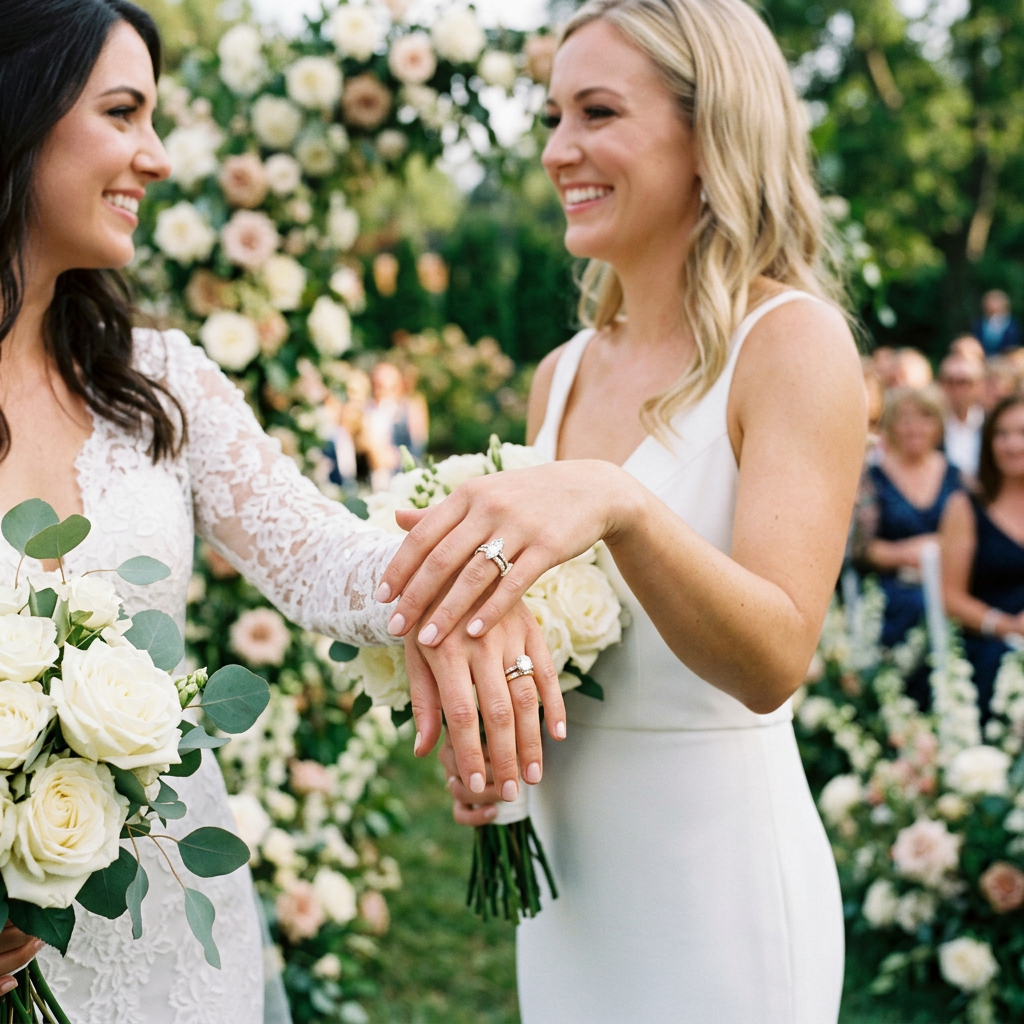
I was reading this article on History Facts about ‘why do brides always stand on the left at weddings’. There’s a line “the groom sometimes needed to use his right hand to receive the bride from her father or place the ring”
So that got me thinking about wedding rings. And all that thinking led me to here where I am writing about this tiny loop of metal we slide onto our fingers. It’s basically nothing more then that. Yet, we humans have been obsessively sliding them onto each other’s fingers for forever. As I started looking into this I went down a total rabbit hole wondering why this specific tradition stuck around so long. Here is what I found.

If you look back at the history books, Egyptian pharaohs are the ones usually credited with turning rings into symbols of eternity. Honestly, their logic was pretty flawless: a circle doesn’t have a beginning, and it definitely doesn’t have an end. Plus, to the ancient Egyptians, that shape perfectly mirrored the sun and the moon they worshipped. It carried a ton of spiritual weight.
Thanks for reading! Subscribe for free to receive new posts and support my work.
I learned that those first early rings were just braided together from river reeds and hemp. Makes sense really, but let’s be real, reeds fray. It turns out that a concept as heavy as “eternity” required a much tougher material.
The Greeks picked up the ring-wearing habit after Alexander the Great marched his way into Egypt. Then, Rome conquered Greece and brought rings right into their official marriage ceremonies. They usually forged them out of basic iron or copper.
Fun side note: some of these ancient Roman bands actually had tiny keys carved right into the metal. It was a completely literal way of saying, “Congrats, you’re now in charge of the household storage chests.”By the second century, though, everyone wanted gold. The Romans never met a status symbol they didn’t want to immediately flex.
The Romans are also the ones who spread the myth that a specific vein runs straight from the fourth finger of the left hand directly to the heart. They dubbed it the vena amoris (the “vein of love”). Biologically? Total fiction. It doesn’t exist. But we kept the tradition anyway—and we definitely kept the finger.
For a really long stretch of the Middle Ages in England, getting married didn’t involve a big church or a priest. It was basically just a matter of private consent. If two people agreed to be together and swapped a token—back then called a “wed”—that was the whole deal. No witnesses. No paperwork.
Of course, that total lack of accountability meant one person could easily bounce a few years later and claim the whole thing never even happened.
That chaos changed in the 12th century. The Christian church stepped in, declared marriage a holy sacrament, and built a strict public ceremony around it. The ring went from a sketchy private secret to a massive public ritual. The new rule was clear: don’t slide a ring onto a finger unless you absolutely mean it for life.
In 1477, Archduke Maximilian of Austria handed Mary of Burgundy a diamond ring set with tiny, flat stones that spelled out the letter M. That is officially on the books as the first famous diamond engagement ring in history.
But for the next few centuries? Diamonds were just one random choice among a sea of other gemstones.
Then the Great Depression hit, sales absolutely tanked, and the De Beers diamond cartel got desperate. They launched a massive marketing blitz. In 1947, a copywriter named Mary Frances Gerety scribbled down four iconic words at the N.W. Ayer & Son ad agency: “A diamond is forever.”
That one campaign completely shifted our culture. The percentage of American brides getting a diamond engagement ring went from a tiny 10 percent in 1939 to a massive 80 percent by 1990. A single line of ad copy completely rewrote how the world gets married. That was a masterclass in marketing.
Grooms didn’t even start wearing rings until super recently, either. A poll from 1947 showed that only about one in three grooms bought a wedding band. It wasn’t until the mid-1950s that jewelry stores started heavily pushing the men’s wedding band as its own mandatory purchase. The “traditional” double-ring ceremony we assume is ancient history is actually younger than most of our grandparents.
When you step back and look at this entire timeline, one specific thread keeps jumping out at me. For the vast majority of human history, a wedding ring has been a promise spoken out loud, completely independent of whether a government clerk signed off on a piece of paper.
Queer couples know this truth deeply. So many of us wore our rings for decades before any state or federal government even thought about recognizing our marriages. The ring mattered because we said it mattered. The Windsor ruling in 2013 and Obergefell v. Hodges on June 26, 2015 made it official. The wedding rings on our fingers now signified something more.
In a world where we can text our vows or announce a relationship status to thousands of people in four seconds flat, we don’t technically need a piece of metal to prove anything to a county clerk.
Yet, we still wear wedding rings. Personally, I think it’s because the ring is physical. It’s a tiny, unmoving, stubborn little constant sitting right there on your hand. A stranger glances at your fingers and instantly knows you’re spoken for. You find yourself absentmindedly spinning it during a brutal afternoon meeting. It leaves a deep, temporary dent when you slide it off, and a distinct pale stripe if you spend a long summer outdoors without it. It acts as a quiet, daily reminder that you made a definitive choice, and someone out there chose you right back.
After thousands of years of human history, nobody has ever managed to invent a better way to say it.
– David
Check out all of our wedding essentials here »